
Does ranking on Google get you cited by AI?
Published . Updated .
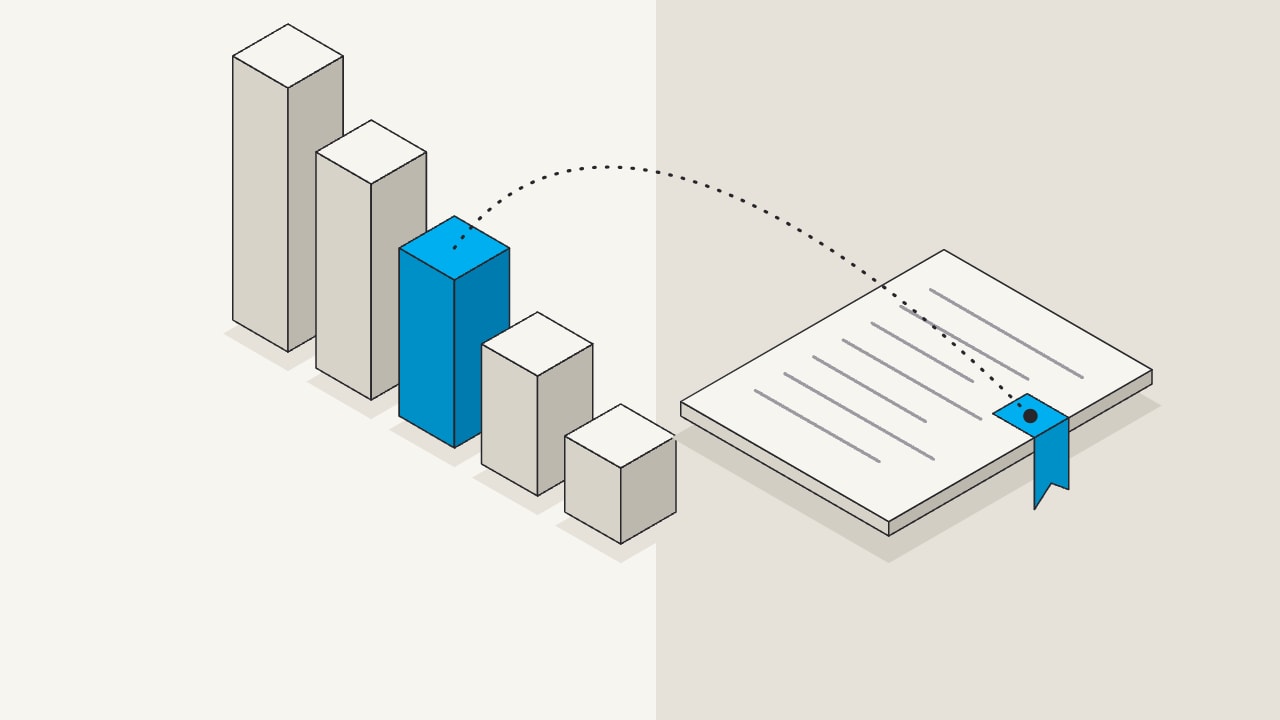
Ranking helps most with Google's own AI answers and least with ChatGPT. In the published studies, between 38% and 93% of what Google's AI features cited ranked in Google's top ten for the question, against 6% to 30% for ChatGPT, and every study measured overlap, so none shows that a higher rank causes a citation.
A citation is the link an assistant attaches to a claim, as our guide to AI citations explains. Below we line up six studies engine by engine with the yardstick each used, set out why their figures disagree, and show from our own recordings how far the searches an assistant writes move away from the question you typed.
How often do AI answers cite pages that rank in Google's top ten?
Often for Google's AI Overviews and AI Mode, rarely for ChatGPT, with Perplexity and Claude in between. These are the six studies we found that compare AI citations with search rankings, with what each one counted.
| Study | What it measured | What it found |
|---|---|---|
| Ahrefs, July 2025 | 1.9 million citations from 1 million AI Overviews, the top three citations of each, against Google's results for the query | 76.1% in Google's top ten and about 86% in the top 100. The median top-cited page ranked second |
| Ahrefs, March 2026 | About 4 million AI Overview URLs on 863,000 Google results pages | 37.9% in the top ten, 31.2% at positions 11 to 100 and 31.0% outside the top 100 |
| CiteLens, July 2026 | 320 templated buyer questions in the Turkish market, run in June 2026, matched by domain rather than by page | Google's top ten held 93% of AI Mode's sources, 89% of Perplexity's, 53% of Claude's and 30% of ChatGPT's |
| Ahrefs, August 2025 | 15,000 long-tail questions across four assistants, ChatGPT data from July 2025 | Google's top ten held 8.0% of ChatGPT's in-text citations, 8.2% of Gemini's, 8.6% of Copilot's and 28.6% of Perplexity's, about 12% on average. Bing's top ten averaged about 10% |
| Grossman and others, April 2026 | 11,500 queries run through Google Search, AI Overviews and Gemini | The three shared few sources, with an average Jaccard similarity below 0.2, and AI Overviews varied more between runs |
| Chen and Koudas, October 2026 | 158,099 answers and 468,037 citations from ChatGPT, Gemini and Perplexity, with ChatGPT's searches replayed through its API | Every page ChatGPT cited was one its own search retrieved, and its sub-queries rarely matched Google's or Bing's results |
CiteLens sells AI visibility tracking and shares its data only on request, so treat its figures as a vendor's. Ahrefs also counted ChatGPT's reference list separately from its in-text links, and 6.1% of those references ranked in Google's top ten.
Why do the studies disagree so much?
Because they measure different engines against different yardsticks, and every one of them compares citations with the ranking for the question, not for the searches the assistant ran.
| What changes | How it moves the figure |
|---|---|
| The engine | Google says its AI features retrieve pages "by relying on our core Search ranking systems", so they start from its index. ChatGPT runs its own searches and cites from those |
| Top ten or top 100 | Ahrefs' 2025 AI Overview figure goes from 76.1% to about 86% when the line moves from ten to 100 |
| Page or domain | A domain match counts any page on the site, so it scores higher than a page match. CiteLens matched domains, the Ahrefs studies matched URLs |
| The questions | Ahrefs used 15,000 long-tail questions, CiteLens 320 buyer questions in one country |
| The date and the model | AI Overviews moved to Gemini 3 in January 2026, which Ahrefs names as one possible reason for its lower count. Ahrefs also changed how it reads the results pages and does not say how much of the fall that explains |
The last row explains the biggest gap on the list. Ahrefs offers three possible reasons for the drop from 76.1% to 37.9%: the new model, AI Overviews that "may be" drawing on the results of their own sub-queries, and its own better parsing. None of the six studies checked the sub-queries themselves.
Does a higher Google rank cause more AI citations?
No study has shown that it does. Each one counted how often cited pages also rank, which is a correlation, and a page can rank and be cited for the same underlying reason, such as answering the question plainly on a page that search engines can crawl.
For ChatGPT, Chen and Koudas found the order works the other way round. Which pages ChatGPT's own search retrieved explained 32% of the difference between cited and uncited pages, and the pages' own properties explained 2.8%. Google's rank for your question only matters to ChatGPT if its search returns the same pages, and its sub-queries rarely did.
For Google's own AI answers, rank and citation share a source. Google's guide to AI features says "The best practices for SEO continue to be relevant because our generative AI features on Google Search are rooted in our core Search ranking and quality systems" (Google Search Central, updated 10 July 2026). Even there, 31.0% of AI Overview citations in Ahrefs' March 2026 count sat outside the top 100 for the query.
Which searches does the answer actually come from?
The ones the assistant writes, which are rarely the question as typed and often not ordinary web searches at all. Google defines query fan-out as "a set of concurrent, related queries generated by the model to request more information and fetch additional relevant search results", and our recordings show how far those searches move from the question.
- In a ChatGPT turn we recorded on 9 September 2026, one request for local recommendations became 17 searches in three calls. Seven were business searches for places and three were image searches, so only seven used ordinary web results, as our post on ChatGPT's four kinds of fan-out query shows line by line.
- On 10 and 11 September 2026 we asked Claude and Grok to compare secondary maths tuition centres in Jurong East, Singapore. Claude ran four searches, three of them places searches. Grok ran eight web searches, and four of them named a single centre, such as
Matrix Math Jurong East fees class size reviews.
On 13 November 2026 we searched Bing, set to Singapore, for the request's own wording. Nine of the ten web results were directories or best-of lists and one was a tuition company's own page. None of the four centres Grok went on to search by name had its own site in those ten, and Matrix Math showed only in Bing's map box above them. Google stopped our automated check, so this is Bing's view of one search on one day.
None of the six studies would pick this up, because each compared citations with the ranking for the question. Ranking for the question would have put a centre next to the lists, while the searches that named a centre were where its own page could come up. Our comparison of fan-out queries and keywords lists all twelve of those searches word by word. If your page was fetched and still left out, our post on why ChatGPT read your page but did not cite it covers what happens after the search.
What should you track instead of your Google rank for the question?
Your rank for the searches the assistants actually ran, and whether those turns fetched and cited you. Keep tracking the rank for the question too, since Google's own AI answers draw on it.
- Add Only Fan Out to Chrome and open its side panel on a ChatGPT, Claude or Grok tab.
- Ask the questions your buyers ask, one per chat, and let each answer finish.
- Export the turn to CSV to get the queries in the order they ran, with the fetched and cited pages.
- Check where your page ranks for each recorded web query, and note the search type, since a places or image search does not draw on the web rankings.
- Add your domain to the watchlist, then search History for it to see which turns fetched or cited you. Our guide to fetched and cited sources explains why the two lists differ.
- Ask the same questions again on another day and group the queries by what they look for, such as fees, reviews or a location.
Do not answer the list with a new page per query. Google warns that creating separate content for fan-out queries "primarily to manipulate rankings or generative AI responses in Google Search violates Google's scaled content abuse spam policy". Put each fact a group looks for on one page that already answers the question.
Related questions
Is a Google ranking a ranking factor for ChatGPT?
Not directly. ChatGPT cites pages its own search retrieved, and Chen and Koudas found its sub-queries rarely matched Google's or Bing's results. In Ahrefs' 2025 study, 8.0% of ChatGPT's in-text citations ranked in Google's top ten for the question.
Do AI Overviews only cite top-ten pages?
No. In Ahrefs' March 2026 study, 37.9% of AI Overview citations ranked in Google's top ten for the query, 31.2% at positions 11 to 100 and 31.0% outside the top 100.
Should I stop doing SEO for AI search?
No. Google says its AI features are rooted in its core Search ranking and quality systems, and ChatGPT can only cite pages its own search finds. Aim the work at the searches the assistants run as well as the question people type.
See the fan-out for your own prompts
Only Fan Out is a free Chrome side panel that lists the queries, fetched pages and cited pages behind each ChatGPT, Claude or Grok answer. Nothing leaves your browser.
Add to Chrome, it's free