
What do ChatGPT's product cards show next to its cited sources?
Published . Updated .
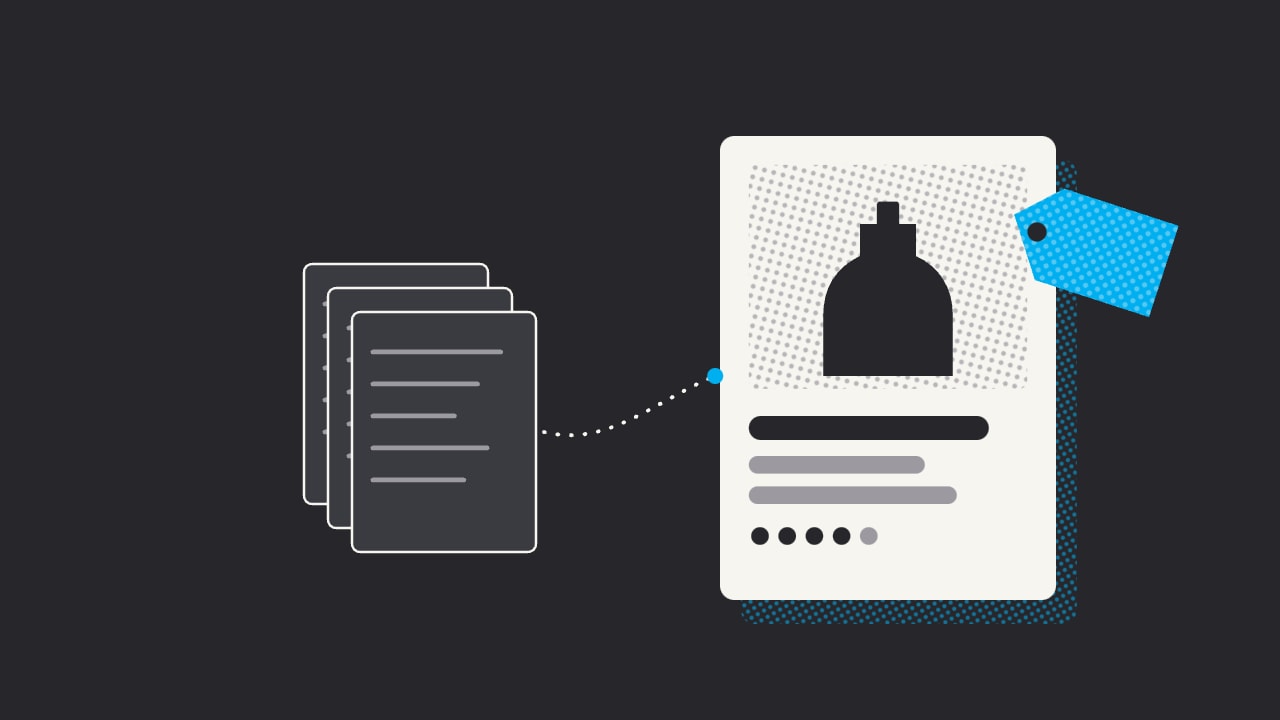
A ChatGPT product card shows a picture, a product name, one price, one merchant, a star rating with a review count, and a list of other shops selling the same item. The cards sit in their own block, apart from the pages ChatGPT cites, and in the shopping answer we took apart below, none of the 16 shops on the cards was among the pages it cited.
Product cards come from a separate product lookup inside step 2 of how ChatGPT, Claude and Grok search the web, next to the web searches that find the pages it cites. The example here is a real ChatGPT answer to the prompt "gifts for men", saved on 9 December 2025 from the GPT-5.1 model, which we keep as a test case for the Only Fan Out parser. ChatGPT has changed how it writes searches since then, so treat the field names as a snapshot. OpenAI's help page, read on 14 November 2026, still describes the same parts of a card.
What does a ChatGPT product card show?
Seven parts, and OpenAI attaches a caveat to most of them. The table sets what the December 2025 answer held beside what OpenAI's Shopping with ChatGPT Search help page says.
| Part of the card | What the answer held | What OpenAI says |
|---|---|---|
| Picture | A product image on every card | Product options can show "imagery, product details, and links" |
| Name | A short product name, such as "YETI Rambler Tumbler" | ChatGPT "may generate simplified product titles and descriptions" |
| Price | One price per card, taken from the first shop listed | Prices "typically reflect the price from the first merchant listed" and come from third-party providers |
| Merchant | One shop name, or the shop plus "and others" | Merchants are ranked by availability, price, quality and whether they make or mainly sell the item |
| Rating | Stars and a review count on 6 of 8 cards, each with its own source link | "Reviews and ratings are not verified by OpenAI" |
| Other shops | 1 to 5 offers per card, one tagged "Best price" | Selecting a product can show a list of merchants offering it |
| Buy in ChatGPT | Marked as not open to checkout in ChatGPT on all 22 offers | Some eligible products and merchants may show an Instant Checkout option |
How are product cards different from ChatGPT's cited sources?
They come from different places and point to different sites. Cited sources are pages from ChatGPT's web searches, marked in the answer text with citation markers. Product cards come from product data, and the answer marks them with a block of its own that lists the chosen products in order.
| In the "gifts for men" answer | Product cards | Cited sources |
|---|---|---|
| How many | 8 cards carrying 22 shop offers from 16 merchants | 3 pages cited, out of 36 pages fetched |
| Which sites | Brand and shop sites such as YETI, Nike, Macy's, Nordstrom, Etsy and Journeys | Gift guides on People, Esquire and eyeandpen.com |
| Where they come from | Product data from outside providers | Two web searches: "best gifts for men gift ideas" and "gift ideas for men what to buy" |
| Overlap | None. No shop on a card was among the 36 fetched pages, so none could be cited | |
So a shop can be on every card and still have no citation, while the gift guides that ranked for the web searches got all the credit in the text. Larger samples show retailers do get cited on other shopping prompts. Ahrefs sorted the cited sources of 4,000 US ChatGPT prompts in October 2026 and found retailers led shopping citations with 28%, with Walmart cited in 11% of shopping answers. Count a card and a citation as two separate results. Our post on why ChatGPT read your page but did not cite it treats a product card as one reason a page goes uncited.
Profound's study of 201,137 prompt runs in mid-2026 counted 812,190 product cards, about four per prompt, and found 87.3 percent of them built from web crawl data and 12.7 percent from merchant feeds. Our single answer showed eight.
Is the price on a ChatGPT product card the lowest price?
Not always. The card shows the first shop's price, and on three of the eight cards a cheaper shop sat lower in the list with the "Best price" tag.
| Card | Price on the card | Offer tagged "Best price" |
|---|---|---|
| Nike Men's Club Fleece Hoodie | $65.00 from Nike | $47.99 from Macy's |
| YSL Men's Fragrance Discovery Set | $75.00 from Nordstrom | $63.75 from Macy's |
| Dior Sauvage Gift Set | $227.00 from DIOR | $192.95 from Macy's |
That matches OpenAI's wording, and on two of the three cards the first shop was the brand itself, which fits the "maker or primary seller" factor in its merchant ranking. On the other five cards, the first shop was also the cheapest. Both Etsy offers showed an original price above the price, $12.93 above $10.99 and $11.80 above $5.90.
For a brand, this means your own store can headline the card at full price while a retailer underneath it wins the "Best price" tag. For a retailer, it means the tag is how you get seen on a card led by someone else.
Where does the star rating on a ChatGPT product card come from?
From a page the card links on its own, and it is not always the shop the card names. Six of the eight cards carried a rating, and on three of them the rating linked to a different shop from the card's own product link.
- The YETI Rambler Tumbler card linked to yeti.com, and its 4.7 rating from 38,989 reviews pointed to a DICK'S Sporting Goods page.
- The Nike hoodie card linked to nike.com, and its rating also pointed to DICK'S Sporting Goods.
- The Dior gift set card linked to dior.com, and its rating pointed to Nordstrom.
- The two Etsy cards, for an engraved barbecue set and a multi-tool, had no rating at all.
OpenAI says it does not verify reviews or ratings, and that review summaries are written by the model from public reviews. If you sell a product, check which retailer's reviews stand on your card, because shoppers read that number as yours.
How does ChatGPT choose which products get a card?
OpenAI says a product appears when ChatGPT judges it relevant to the request, using the query and context such as Memory or custom instructions, and that not every product available is shown. The December 2025 answer shows the cut in numbers.
- Each product result carries a reference such as
turn0product0. The references in this answer ran up toturn0product15, so at least 16 product results came back. - Eight were shown, in the order 0, 3, 1, 2, 8, 4, 14, 15. ChatGPT reordered them and skipped at least half.
- Each of the eight appeared twice: once in the card row at the top, and again as a product mention inside the written list, under headings such as "Fragrance & Style".
Product lookups are written apart from web searches. In later answers, ChatGPT has written them on their own line starting product|, as our guide to ChatGPT's four kinds of fan-out query shows.
Are ChatGPT product cards ads?
No. OpenAI says product results "are selected independently by ChatGPT and are not ads, nor influenced by any OpenAI partnerships," and that "Ads are separate from product results."
Paid product ads do exist now. OpenAI's developer guide to product feeds for ChatGPT ads describes uploading a catalogue, choosing a product set for each ad group, and marking each product with is_ads_eligible. That catalogue follows the same product file format as OpenAI's commerce feed. Search Engine Roundtable reported more product set filters in Ads Manager on 12 November 2026. When you count how often your products show up, keep paid placements out of the count of cards.
How does a shop get its products onto ChatGPT's cards?
OpenAI's help page points to three ways product data reaches ChatGPT, and none of them guarantees a card.
- Third-party providers. Prices and product data come from outside providers, so keep the price, stock and product details on your own pages current, and let OAI-SearchBot crawl them.
- Shopify Catalog. Shopify merchants have their product data passed to ChatGPT through it.
- A direct product feed. Merchants can read OpenAI's product feed documentation and apply for direct feed access.
The citations are a separate job. In our example the text credit went to gift guides that ranked for ChatGPT's two web searches, so a guide or comparison page that answers those searches is how a shop earns a citation as well as a card.
How do you see product cards and cited sources side by side?
Record the answer with a tool that keeps both lists. The steps with Only Fan Out:
- Add the extension, open chatgpt.com and click its toolbar icon to open the side panel.
- Send a shopping prompt as normal.
- Read the Products section. Each card shows its picture, name, price, merchant, rating and review count, the other shops' offers, and whether it sat in the card row or inside the text.
- Read the cited sources above it, grouped into web citations, footnote sources and products, to see which sites got the text credit.
- Export the conversation as CSV. You get three files, for queries, sources and products, and the products file lists each card's merchant, price, rating, review count and selection order.
To find the product lines in ChatGPT's own response without an extension, our guide to finding ChatGPT's fan-out queries in Chrome DevTools shows where they sit.
Related questions
Does ChatGPT cite the shops on its product cards?
Not necessarily. None of the 16 shops on the cards in our December 2025 example was among the pages ChatGPT fetched or cited. Ahrefs found retailers made up 28% of shopping citations across 4,000 US prompts in October 2026, so count a card and a citation as separate results.
Can you pay to get onto ChatGPT's product cards?
No. OpenAI says product results are selected by ChatGPT, are not ads and are not influenced by its partnerships. Ads can draw on a product feed, but OpenAI shows them apart from product results.
Why is the price on a ChatGPT card different from the shop's price?
Prices come from third-party providers, and the card usually shows the first merchant's price, which may not be the lowest. OpenAI says price changes can take time to show. Open the card to see the other shops and their prices.
See the fan-out for your own prompts
Only Fan Out is a free Chrome side panel that lists the queries, fetched pages and cited pages behind each ChatGPT, Claude or Grok answer. Nothing leaves your browser.
Add to Chrome, it's free